

Poor lighting is one of the most consistently underestimated safety risks on working livery yards. It costs relatively little to address and has a direct impact on daily operations, yet it’s regularly put off until an incident makes it urgent.
For yard owners thinking about where to invest in facilities this season, luxury outdoor lighting is worth treating as infrastructure rather than an aesthetic choice. The British Horse Society’s 2025 safety guidance cites poor visibility as a leading contributing factor in stable accidents, particularly during early morning and evening routines when the majority of yard activity takes place outside daylight hours in winter.
This guide covers the key areas of a livery yard where lighting has the most operational impact, what to specify, and how to approach an upgrade practically and within budget.
Why Most Yards Have a Lighting Problem They Haven’t Fixed
Single-point coverage is the most common setup on smaller yards, typically one floodlight over the stable block. It handles the immediate area but leaves everything else in shadow: the entrance track, field gateways, the muck heap area, water troughs, and the car park.
The problem isn’t simply darkness. A single bright fixture surrounded by deep shadow actually reduces overall visibility by affecting how eyes adjust. The contrast makes the unlit areas harder to see than if there were no artificial light at all. Distributing light more evenly across movement areas is both safer and more practical.
A 2025 survey conducted by the National Equine Welfare Council found that 43% of yard-related incidents occurred in low-light conditions, with the majority taking place away from the main stable block. These are exactly the areas single-point lighting misses.
Entrance and Arrival Areas
The entrance is the first thing a prospective livery sees, and the last thing they see when they leave late. Consistent lighting here communicates that the yard is well managed, something that influences both first impressions during viewings and day-to-day confidence for existing clients.
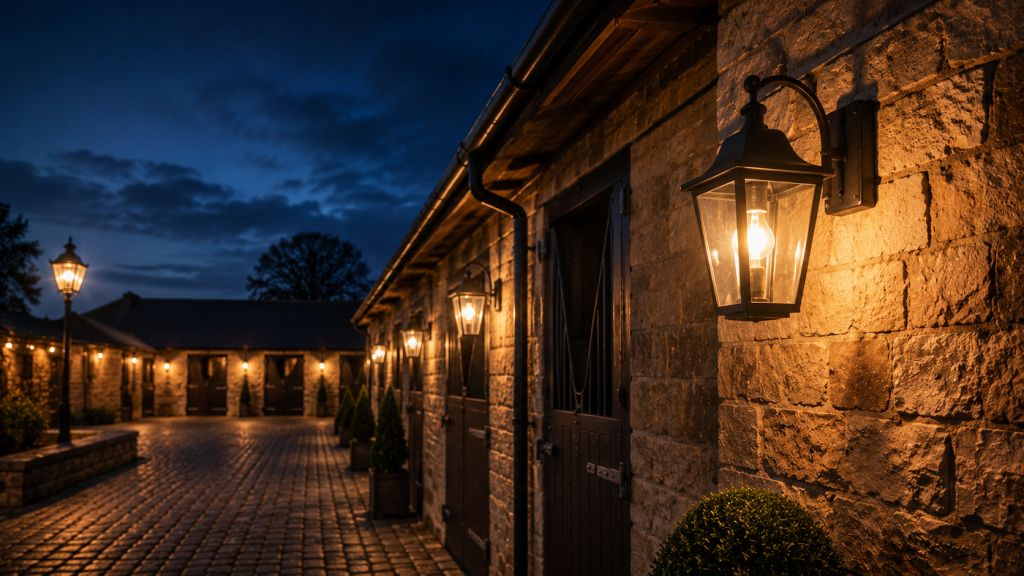
Post mounted lanterns or wall fixed fittings with a colour temperature between 2700K and 3000K are well suited to this purpose. Warm white output is more appropriate in a rural yard setting than cool white, which tends to read as industrial. IP65 rated units are the minimum standard for outdoor use and should be specified for any fitting exposed to mud, water, and British weather.
When prospective liveries are researching yards in your area through resources like the LiveryList yard directory, a well-presented, consistently lit entrance makes a tangible difference to how your facility is received at a viewing.
Stable Block, Corridors, and Working Areas
Consistency of light matters more than brightness in working areas. Horses react adversely to sudden transitions between bright and dark zones, flickering, and deep shadows in familiar areas. These responses can create handling risks that are straightforward to eliminate with the right setup.
Low-level wall-mounted lighting along stable corridors, combined with overhead coverage at feed rooms, tack rooms, and wash bays, produces a calmer and safer working environment. For areas requiring higher illuminance, such as examination bays and foaling boxes, directional fittings at 300 lux or above are the appropriate standard. The Chartered Institution of Building Services Engineers recommends 100 to 200 lux for routine equestrian work, rising to 300 lux at veterinary examination points.
For yards looking to improve both function and presentation in working areas, modern wall sconces offer a practical upgrade from standard bulkhead fittings. Mounted at 1.5 to 1.8 metres, they provide directional light at a useful working height, carry a lower catching risk than fittings that protrude significantly from the wall, and hold up well in stable environments when IP ratings are correctly specified. The visual improvement over a bare bulkhead is immediate, and it’s the kind of detail prospective liveries notice during a yard visit.
Security and Perimeter Lighting
Rural equestrian properties face specific security risks. Horses, tack, and equipment represent significant combined value, and perimeter lighting is among the most cost effective deterrents available against opportunistic theft and trespass.
Motion-activated floodlights at field access points and the main gate are the most practical starting point. They draw minimal power during quiet periods and activate when movement is detected. Combined with a camera system connected to a mobile notification, this setup allows yard owners to monitor activity remotely without lights running continuously through the night.
Home Office crime prevention guidance indicates that consistently lit property perimeters reduce opportunistic theft incidents by up to 39% compared to unlit sites. Dusk to dawn sensor fittings at secondary access points and paddock gateways provide reliable overnight coverage without manual operation.
Practical Planning for Phased Upgrades
A full yard lighting upgrade doesn’t need to happen at once. A staged approach allows costs to be managed while addressing the highest-risk areas first.
A practical sequence for most yards would be: entrance and main arrival area first, followed by the stable block and working corridors, then perimeter and field access points as a second phase. LED fittings across all these areas use considerably less power than halogen equivalents, so reduced running costs over a 12-month period should be factored into the overall budget assessment alongside installation costs.
Any work involving new fixed external circuits must be carried out by a registered electrician under Part P of the Building Regulations. Battery powered and plug in fittings have no equivalent requirement, though professional installation is advisable for anything permanently mounted in an outdoor environment.
Most Common Queries
Does yard lighting affect livery retention?
Yes. Liveries assess a yard’s overall standard of management continuously, and lighting is one of the more visible indicators. A facility that is poorly lit raises questions about maintenance standards generally, even when other areas are well managed. Consistent, functional lighting is a practical signal of a yard that takes its obligations seriously.
What IP rating should outdoor equestrian fittings carry?
IP65 as a minimum for general outdoor use. This covers protection against dust and directional water jets, which is appropriate for the typical exposure levels in a stable yard environment. IP66 or IP67 should be specified for fittings installed near wash bays or areas subject to heavy water use. Ratings are defined under BS EN 60529 and must appear on any product specification sheet from a reputable supplier.
How much does a yard lighting upgrade typically cost?
Costs vary considerably based on yard size, existing infrastructure, and the extent of the work required. For a small to medium yard of 10 to 15 stables, a phased upgrade covering the entrance, stable block, and perimeter is achievable across two budget cycles. LED running costs are meaningfully lower than halogen over a 12-month period, which reduces the net cost of the investment over time and should be included in any cost-benefit assessment.
Can yard owners install external lighting themselves?
Fixed external wiring, including new circuits and consumer unit connections, must be carried out by a registered electrician or formally notified to building control under Part P of the Building Regulations. Plug in or battery powered fittings fall outside this requirement. For permanently installed outdoor fittings, professional installation is strongly advisable regardless of the regulatory position.
Conclusion
Yard lighting sits at the intersection of safety compliance, insurance liability, and the daily experience of every livery who uses your facility. It’s not a cosmetic consideration. It’s a functional one, and it affects everything from how confidently horses are handled in low-light conditions to how your yard is perceived during winter viewings.
The yards that compete well for liveries tend to be the ones that manage the full operational picture, not just the headline facilities. Addressing lighting properly, starting with the areas of highest daily impact, is a straightforward way to improve both safety standards and the overall impression your yard makes.
If there are gaps in your current setup, the most useful next step is a simple walkthrough of the yard after dark. Most problem areas become obvious within a few minutes. What you find will tell you where to start.