


Warm weather brings longer evenings, more time outdoors and a busier competition calendar – but it also places extra demands on your horse’s body. Increased sweating, changes in routine and travelling can all affect hydration, comfort and performance. The good news is that a few simple management adjustments can make a huge difference to your horse.
This guide focuses on three of the most important things every owner should know this summer: how to cool a horse down properly, when it’s safe to ride and how to spot the early signs of heat stress before they become a problem.
The Best Way to Cool a Horse Down
Advice on cooling has changed in recent years, and it’s worth updating your approach if you haven’t already.
Continuous application of cool water is now recognised as one of the most effective ways to bring a horse’s temperature down – and the key word is continuous. Remove tack promptly, move your horse into shade if possible, encourage airflow and keep applying cool water until breathing and heart rate start returning to normal.
Resist the old habit of scraping the water off. As water evaporates from the coat, it draws heat away from the body – the same principle behind sweat cooling us down. Scraping the water off interrupts this process and removes much of the cooling benefit. Instead, keep reapplying water as it warms and let a thin film evaporate naturally, especially if there’s a breeze.
It’s also worth thinking about encouraging drinking, not just cooling from the outside. A “water buffet” – offering several buckets with different additions such as a little soaked feed, or a hindgut supplement for horses like Equell Gut Food which is rich in natural herbs and botanicals – gives your horse options and can encourage more consistent drinking, while also supporting gut health during a season when routines are often disrupted. Always make sure you have plain, clean, fresh water available alongside any water buffet options.
When Should You Ride in Hot Weather?
Temperature alone doesn’t tell the whole story. Humidity plays an equally significant role, and the combination of the two is known as the Heat Index – a measure of how hot conditions actually feel and how much strain they place on a horse’s ability to cool down.
As a general guide:
- Once air temperature climbs above roughly 32°C and relative humidity exceeds around 70%, the risk of heat stress rises sharply.
- Horses cool primarily through sweat evaporation. When humidity is high, sweat can’t evaporate efficiently, so this natural cooling process becomes far less effective – even if the air doesn’t feel unbearably hot to us.
Our useful heat index chart below can help you judge conditions at a glance:
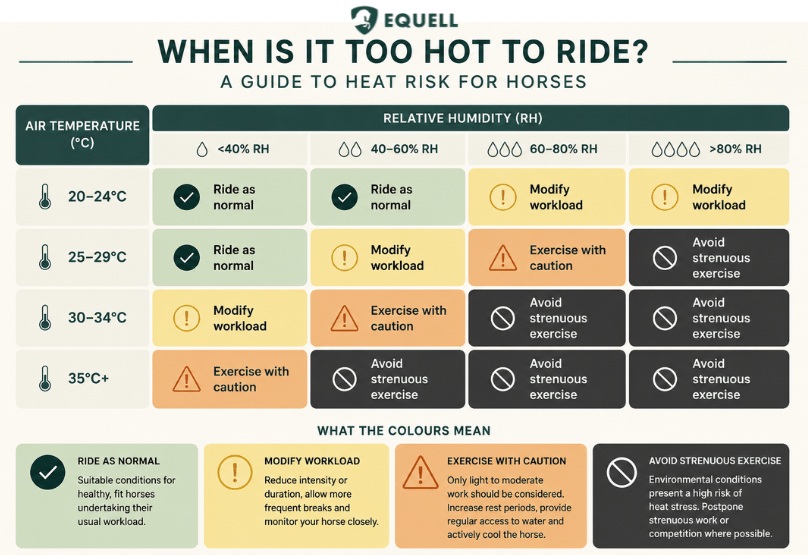
It’s worth remembering that horses face a steeper cooling challenge than we do. A large proportion of their body is active muscle, which generates significant heat during exercise, while their relatively small surface area limits how much heat they can shed through sweating. This combination makes them considerably more prone to overheating than humans in the same conditions.
Where possible:
- Ride early morning or later in the evening, avoiding peak heat.
- Work in shaded areas.
- Reduce intensity on very hot or humid days.
- Allow longer warm-down periods and extra recovery time.
- Give your horse the chance to drink before and after exercise.
Don’t forget that travelling and competing add to heat load even before exercise starts – standing in a lorry or trailer builds up heat quickly, so good ventilation and plenty of water on the move matter just as much as what happens once you’re there.
A quick note of caution: this heat index chart is a general guide, not a rule. Fitness, acclimatisation, wind, cloud cover and workload all affect individual risk – if in doubt, don’t ride.
Recognising the Early Signs of Heat Stress
Most horses cope well with warm weather, but knowing the early warning signs means you can act before things escalate. Watch for:
- Excessive or prolonged sweating
- Rapid breathing
- Slow recovery after exercise
- Lethargy or reluctance to work
- Reduced appetite
- Poor performance
- Noticeable changes in behaviour
If you notice any of these, stop exercise immediately, move your horse somewhere cool, offer clean drinking water, and begin active cooling (following the continuous-water method above) until things start to stabilise. If your horse doesn’t improve, contact your vet without delay.
Don’t Forget Electrolytes
Cooling and timing get most of the attention in hot weather, but hydration chemistry matters just as much behind the scenes.
When horses sweat, they lose significant amounts of electrolytes – sodium, potassium, chloride and magnesium – not just water. Without these electrolytes in balance, the thirst mechanism itself becomes less effective, meaning a horse may not feel the urge to drink enough to properly rehydrate, even with water freely available. Feeding electrolytes for horses in the run-up to strenuous exercise or competition – and ideally year-round during warmer months – helps keep this mechanism working as it should and allows minerals to be replaced as they are used, rather than levels becoming depleted.
The Bottom Line
Good summer management isn’t about a complicated routine – it’s about getting the fundamentals right: plenty of water, sensible timing around exercise, proper cooling technique, and knowing what to watch out for. Get those in place, and both horse and rider are far better equipped to enjoy everything the summer months have to offer.
References:
- US Equestrian (USEF) – Heat Alert: Clarification and Recommendations for Competitions (2024)
- Fédération Equestre Internationale (FEI) – Beat the Heat
- Kang H. et al. (2023). Heat stress in horses: A literature review. International Journal of Biometeorology.
- Verdegaal, E.-J.M.M., et al. (2020). Effects of Pre-Cooling on Thermophysiological Responses in Elite Eventing Horses. Animals.