

Many different people come and go throughout the day at busy equestrian yards. Both yards may share the same entrances, pathways, arenas and stable areas so those using them staff, horse owners/instructors/contractors/volunteers/riders and visitors need to be kept apart. There will be quieter days where you can spot everyone easily. However, when we have open days or competitions or busy times it can be much more difficult to know who is doing what.
A yard identification system streamlines organisation and communication. Identification is not a substitute for good security procedures but can be an integral part of a wider strategy for managing people on an equestrian site.
Know Who Use the Yard on regular Basis
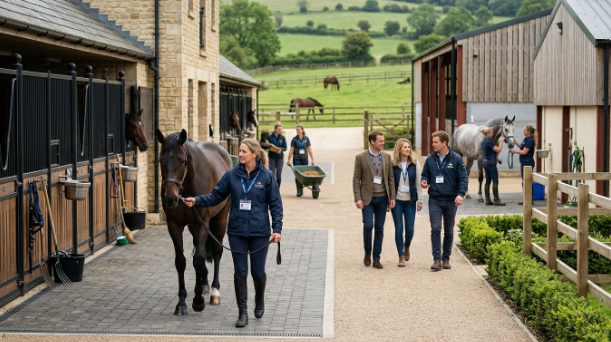
The first thing that you have to do is to make sure that you know all those groups of people whom we need to identify.
The most recognisable group of workers would be permanent yard lumpers since they work alongside every day. But a yard might also include freelance instructors, farriers, vets, delivery drivers, maintenance workers or temp help and volunteers.
The horse owners and liveries might need to be differentiated from a casual visitor. There may also be judges, stewards, competitors, photographers and medical personnel present at an event.
By creating a few simple categories, it becomes necessary and easy to determine what identification each group needs.
Provide Staff with a Distinctive and Uniform Identifier
Staff must be familiarised without repeated introductions. In some cases, this could be a name badge or identification card while in others it might be clothing with identifying markings such as a bright color, patch and more.
Simple is usually the most helpful information. For everyday yard operations, the name of a person and what she does is most likely sufficient information. For bigger premises, the other choice is to incorporate the yard or establishment name.
Consistency is important. If every staff member utilises a wholly different identification method, visitors may still have difficulty in identifying who can help them.
Use Temporary Identification for Visitors
Visitors can pose a unique challenge since their presence may be limited to a relatively short span of time on the property.
That begins with a simple check in process. After checking in, visitors receive a temporary ID that explains where they can visit, and who to wave for help.
They are particularly useful in busy times when many strangers are coming in at the same time. They also help staff to identify between a visitor and someone who is regularly in the yard.
The visitor will, where appropriate, return any temporary identification by the end of the visit and sign out.
Create Simple Visual Categories
Easier to read, different colours, labels or symbols help the eye identify immediately.
That is, for example, a yard may employ one visual category for employees and another for visitors and yet another for event officials. This will be system dependent, depending on the size of establishment and what you do.
The key point is to keep the system intuitive. There are other examples, especially in the processing and design of identifiers and namespaces. If people have to memorize an intricate series of codes before being able to decipher an identifier, then not much practical gain has been had from it.
Always rather than fancy designs, clear wording is better and useful. Id badges: A plain and simple label such as (Staff,) or Visitor or Official instantly conveys the nature of a person.
Combine Identification With Sign-In Procedures
Identification is most effective when it integrates into a broader visitor-management process.
A yard can set up a controlled entry point where visitors sign in, get instructions and temporary ID. Since each establishment may vary, the procedure could also include details such as parking, restricted areas, emergency arrangements and visitor supervision.
This is where sign in should be simple not complicated, If it takes too long, visitors and staff will have seen that you can skip this.
Accurate arrival and departure information enables staff to maintain records of present individuals, particularly useful for larger yards and events.
Horse Safety Starts with Thought
Identification around horses must fill a practical role as well as be visible.
Staff or visitor attire should allow free movement and carry out their things without interference. Loose or dangling parts can be unsuitable in locations where people are handling horses, using equipment or passing through tight stable areas.
Identification should therefore be chosen according to the working context for those who regularly handle horses. What works in an office will not work for a stable yard.
Comfort is another consideration. As staff sometimes wear their identification for hours, it should not hinder normal movement or other necessary equipment.
Keep Identification Information Simple
An ID card should not include all possible details.
What is useful information differs in each situation, but usually contains a name of the person you are with, their job title and the yard/event it belongs to. Identification for temporary visitors may just display their visitor status and will tell them what they need to do next.
This enhances the readability if we keep the design clutter-free. If someone was looking across a busy yard, that identifier should be interpretable immediately instead of having to read a bunch of small text.
Traditional lanyards and badge holders are one of the more practical solutions for yards using wearable ID cards to keep identification visible. The suppliers’ combination of 4inlanyards along with ID cards, event badges, badge reels, lanyards and card holders proves how multiple identification parts can fit together to form a unified system.
Plan for Busy Equestrian Events
Clarification can be especially important in instances when a regular lawn transforms into an event space.
Competitions, open days and clinics and demonstrations can have many more people on the property than normal. The participants comprise: riders, officials, judges, stewards, volunteers or people related to their area of activity (doctors and medics who take care of any health problem that may occur at it watching out for the safety)
It allows these groups to quickly identify one another using clean classifications. For case event officials could be searching for a steward, visitors could be looking for someone on staff to assist them.
Especially if the system is to be used by staff and volunteers, event organisers must decide on identification categories before an event occurs and communicate this clearly.
Review the System Regularly
An identification system should not stay static in perpetuity.
This system can be referred to by yard owners and managers whenever staff members change, new contractors are brought in, the understanding of how the property is used changes or when the yard starts hosting more events.
Feedback is another thing we might like to consider. For example, if visitors continually ask who they should talk to or staff members struggle to locate specific groups, these issues might mean the current scheme is in need of modernization.
Last but not least, replace your lost, damaged or expired ID as soon as possible.
Avoid Common Identification Mistakes
A number of simple mistakes can make an otherwise good system with limited power.
Some of these include making identifiers too hard to see, using an excessive amount of categories, not updating staff information, ignoring temporary workers and contractors, or completely depending on identification without necessary visitor procedures.
Another frequent issue is selecting identifications that are not practical for the workplace. You work in an active yard all day long, practicality should always come before aesthetics.
Final Thoughts
Having staff and visitors clearly identified is really about making an equestrian yard more manageable. An effective system does not need to be complex or costly. One way it should look and feel is to ensure it is visible, comprehensible, comfortable and fits with the environment.
Differentiation between groups, sensible sign-in procedures that tie identification with visible means of identification, awareness around horses and regular reviews of the system will enable yard owners to create a more structured process in which all on their property are protected.
This isn’t just about giving people badges or passes, to clarify quickly who is in charge of what, who is allowed to be where and who asks for help when needed.