


A British summer can move quickly between persistent rain and dangerous heat. For racecourses, a sudden rise in temperature affects far more than the comfort of spectators. Thoroughbreds must travel, wait in racecourse stables, parade, gallop at racing speed and recover before returning home.
The British Horseracing Authority (BHA) can alter race times, rearrange the running order or abandon a fixture. Its decisions account for the local forecast, humidity, wind, available water, travel routes and the responses of horses that have already competed.
Four Fixtures Lost to a Red Warning
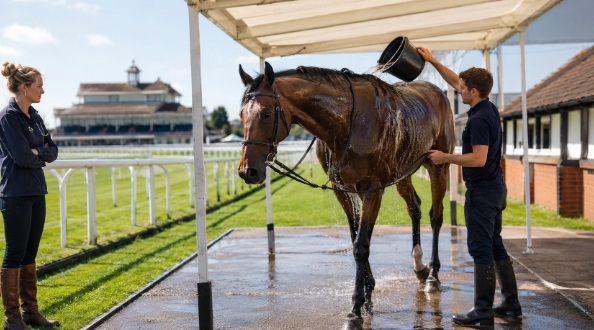
Britain’s June 2026 heatwave provided a clear example. Worcester’s fixture on Wednesday, 24 June was initially moved forward by more than four hours. The first race was rescheduled for 10.30am instead of 2.39pm, with the last due at 1pm rather than 5.17pm. Longer races were placed earlier on the card.
The situation changed when the Met Office issued a red extreme heat warning covering parts of the Midlands, southern England and Wales. The BHA subsequently abandoned Worcester along with three other fixtures.
| Racecourse | Original date | Reason for abandonment |
| Kempton Park | 24 June 2026 | Located inside the red warning zone |
| Salisbury | 24 June 2026 | |
| Worcester | 24 June 2026 | |
| Ffos Las | 24 June 2026 | Required travel through affected areas |
Bookmakers may suspend horse-racing markets when extreme weather changes the starting time, venue or declared field. Prices are usually restored only after the revised programme and runners have been confirmed. During that pause, customers looking beyond racing may compare separate promotions such as no deposit bonus casino Australia. None of these offers affects the BHA’s decision, which is based solely on safety and welfare.
A Red Warning Stops the Journey
The location of the course is only one consideration. Under the BHA policy applied in June 2026, horses could not be transported out of or through an area covered by a Met Office red heat warning. That restriction explains why Ffos Las was abandoned despite lying outside the principal warning zone.
A racehorse might spend several hours in a horsebox before reaching a fixture. Ventilation works best while the vehicle is moving, but congestion or an unexpected stop reduces airflow. Heat generated by several horses can also raise the temperature inside.
The BHA’s official guidance for racing in hot weather asks trainers and their staff to consider several precautions:
- Carry drinking water throughout the journey.
- Travel during a cooler part of the day where possible.
- Arrange arrival the previous evening if suitable stabling is available.
- Take the horse’s temperature after arrival.
- Keep the horse in shade outside its box.
- Ensure sufficient staff are present to assist with cooling.
Water should not be withheld before racing. A dehydrated horse has less capacity to regulate its temperature and is more susceptible to heat stress during strenuous exercise.
Earlier Is Not Always Safer
When conditions remain manageable, the BHA can move a fixture rather than cancel it. The decision depends on when the highest temperature is expected.
Doncaster’s meeting on Friday, 26 June 2026 was brought forward to run between 10.15am and 1.15pm. Yarmouth began at 10.30am and finished at 1.30pm. Both changes followed a Met Office amber warning.
Windsor required the opposite response on Saturday, 27 June. Its first race moved from 1.50pm to 5.15pm, while the final contest was delayed until 8.15pm. Lingfield Park already had an evening programme and needed no comparable adjustment.
These examples show why a fixed summer timetable would be ineffective. An early start may avoid an afternoon peak, whereas an evening card can take advantage of falling temperatures and a returning breeze.
Conditions Are Measured Across the Course
An ordinary temperature reading cannot describe every part of a racecourse. Stable blocks, the pre-parade ring, the parade ring and the winner’s enclosure may have different levels of shade and airflow.
Course staff monitor these areas repeatedly. Predicted temperatures can also be added to going reports so trainers receive advance notice. Parade times and “horses away” announcements may be shortened to prevent runners standing unnecessarily in exposed areas.
Officials consider a combination of factors:
- Ambient temperature and humidity
- Direct sunlight and available shade
- Wind speed and air movement
- Water supply and refill capacity
- Number and distance of remaining races
- Recovery of horses that have already run
- Cases of heat stress or post-race ataxia
A warm but breezy afternoon may be easier to manage than a slightly cooler day with high humidity and still air. Observations made during the meeting are therefore as important as the forecast issued that morning.
Cooling Areas Need More Than a Hose
The unsaddling enclosure is a critical part of hot-weather planning. A Thoroughbred continues producing and retaining heat after it crosses the finish, so cooling must begin promptly.
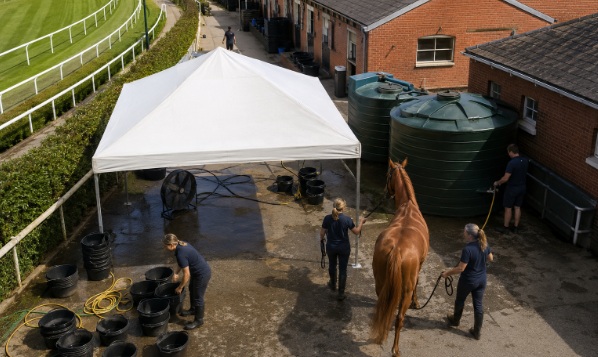
Racecourses may install open-sided shade structures and place large water troughs near the unsaddling area. Buckets are used to collect water because allowing several horses to drink directly from a shared trough would create a biosecurity risk. Ice and fans can provide additional support where required.
A properly prepared cooling station should have:
- copious cold water with a rapid refill system;
- clean buckets for drinking and washing;
- sufficient space for horses to keep walking;
- shade that does not restrict air movement;
- hoses positioned away from busy walkways;
- veterinary staff with clear access to the horse.
Cold water is poured generously over the shoulders, neck, back and quarters. The horse is walked in a shaded, breezy space before the process is repeated. Rugs and sheets are avoided because they can trap heat, while chemical cooling rugs are not recommended by the BHA.
Staff Watch Behaviour as Well as Temperature
A thermometer supplies useful evidence, but staff also assess breathing, expression, movement and recovery time. Shallow panting, anxiety and unsteadiness can indicate that a horse is struggling to dissipate heat.
Another warning sign is synchronous diaphragmatic flutter, commonly known as “thumps”. The diaphragm contracts in rhythm with the heartbeat, producing a noticeable movement around the flank. The condition is associated with disturbances in fluid and electrolyte balance and requires veterinary attention.
If a horse appears abnormal, racecourse veterinary staff must be informed immediately. A jockey may be instructed to dismount on the course so cooling can begin without waiting for the horse to reach the unsaddling enclosure.
Screens can still be used when treatment requires privacy, but their position matters. A tightly enclosed screen may restrict the airflow needed for effective cooling. BHA guidance allows screens to be arranged so that they channel air towards the horse.
Recovery Continues After Breathing Settles
A horse that appears comfortable ten minutes after racing is not necessarily ready to travel. Lameness, overheating and other concerns may become apparent as the horse cools.
A BHA rule approved in April 2026 requires every horse to remain at the racecourse for at least 45 minutes after competing. Earlier departure requires permission from a veterinary officer or equine welfare integrity officer.
The 45-minute period gives the horse time to drink and urinate. It also allows stable staff and veterinary teams to identify changes in movement, behaviour or temperature before another road journey begins.
Post-race care normally includes:
- continued access to fresh water;
- repeated observation of respiratory recovery;
- checking limbs and gait for signs of soreness;
- walking in a shaded, ventilated area;
- delaying loading if recovery is incomplete.
The new requirement makes recovery a defined part of the raceday schedule rather than a brief pause before departure.
Heat Also Changes the Racing Surface
Prolonged hot weather affects the course itself. Turf loses moisture, irrigation evaporates more quickly and heavily used racing lines need time to recover.
Bath Racecourse encountered this problem during dry and windy conditions in June 2025. The course has no permanent watering system and relied on bowsers. After its 25 June meeting, the BHA transferred the following fixture to Chepstow because the surface could not be prepared adequately by 2 July.
Race distances had to be adjusted at the replacement venue. A programmed Class 6 race over one mile and six furlongs became a two-mile contest because of the starts available at Chepstow.
Heat planning therefore connects several operations: horse transport, veterinary cover, staff rotas, irrigation, declarations and fixture scheduling. The safest response may involve an earlier start, an evening programme or no racing at all.